Tag: home maintenance

  • Garage Door Cable Replacement: A Practical Step-by-Step Guide

    Garage Door Cable Replacement: A Practical Step-by-Step Guide

    A frayed or snapped garage door cable is one of those repairs that looks intimidating but is very doable on the extension-spring type of door. In short: you replace a garage door cable by clamping the door in place, releasing spring tension, unhooking the worn cable from the bottom bracket, freeing it from the pulley or drum, and threading the new one along the exact same path before restoring tension. Most homeowners finish the job in one to two hours with basic hand tools.

    Here is the part that matters most, though. If your door uses a torsion spring mounted on a shaft above the opening, the cables sit under enormous tension and a slip can cause serious injury. That version is worth handing to a professional. The walkthrough below tells you how to spot which system you have before you touch anything.

    Repair type Garage door lift cable replacement
    Difficulty Moderate (extension spring) / Pro job (torsion spring)
    Time needed 1 to 2 hours for a DIY-friendly door
    Typical DIY cost $15 to $40 for a pair of cables
    Professional cost $150 to $250 including labour
    Cable lifespan Roughly 8 to 12 years with normal use
    Best replaced In pairs, even if only one has failed
    Key safety note Never unwind a torsion spring without proper winding bars

    What the Cable Actually Does

    Your garage door weighs far more than it feels like when the opener glides it up. The springs carry most of that load, and the cables transfer the spring force to the bottom corners of the door so it rises evenly. When a cable snaps, the door often jams at an angle, drops on one side, or refuses to move at all.

    There are two lift cables, one on each side. They run from the bottom bracket up to either a pulley (extension-spring doors) or a grooved drum near the top (torsion-spring doors). Knowing which of these you have decides the whole job.

    Extension Spring or Torsion Spring? Check First

    Look above and to the sides of the closed door. Long springs stretched along the horizontal tracks on each side mean an extension system. A single fat spring wound tightly around a metal bar directly above the door means a torsion system.

    Extension-spring cable replacement is genuinely beginner-friendly because you can relax the springs simply by opening the door. Torsion cables stay loaded even when the door is up, and that stored energy is what makes them dangerous. The rest of this guide focuses on the extension type; for torsion doors, book a technician.

    Tools and Materials You Will Need

    • Replacement cables sized to your door height (buy the matching pair)
    • Locking pliers or C-clamps to secure the door
    • A sturdy stepladder
    • Adjustable wrench and a socket set
    • Work gloves and safety glasses
    • A helper for the heavier moments (optional but welcome)

    Step-by-Step: Replacing an Extension-Spring Cable

    Open the Door Fully and Lock It

    Raise the door all the way. With it open, the extension springs go slack, which removes tension from the cables. Clamp locking pliers onto the track just under a roller on both sides so the door cannot slide down while you work.

    Disconnect the Opener

    Pull the red emergency release cord so the trolley detaches. This keeps the motor from firing the door mid-repair.

    Unhook the Old Cable

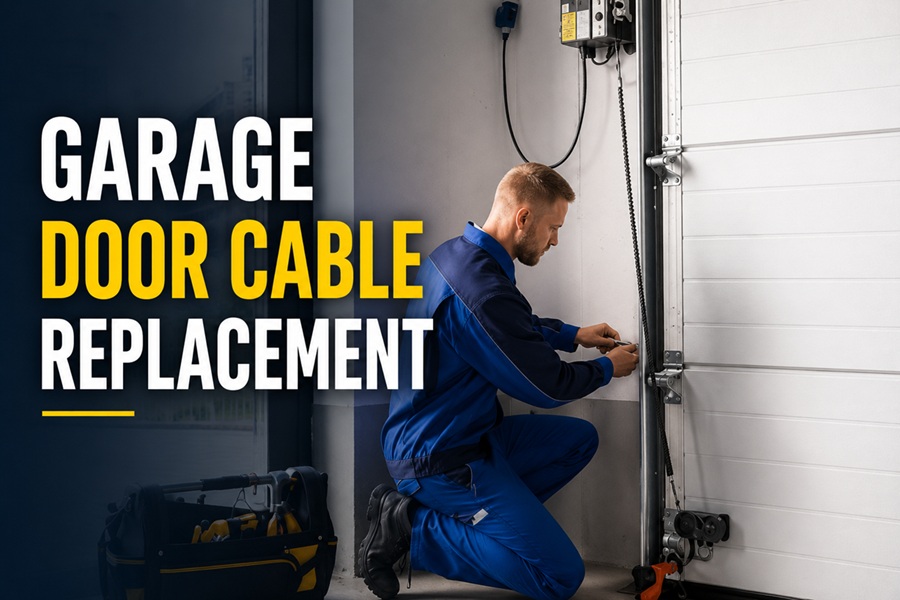
    Follow the failed cable down to the bottom bracket at the corner of the door. The looped end sits on a peg or pin. Slip it off. Then trace the cable up to the pulley system and unthread it, noting the exact route it took.

    Route the New Cable

    Hook the new cable onto the bottom bracket peg first. Run it up over the pulley and back to the anchor point exactly the way the old one ran. A twisted or misrouted cable will bind and wear out fast.

    Remove the Clamps and Test

    Take off the locking pliers slowly and lower the door by hand. Watch both cables stay taut and seated. Reconnect the opener, then run the door up and down a couple of times, listening for scraping or uneven movement.

    Torsion vs Extension at a Glance

    Feature Extension Spring Torsion Spring
    Spring location Along both side tracks On a bar above the door
    Tension when open Released Still loaded
    DIY friendliness Reasonable for beginners Professional recommended
    Special tools Clamps and hand tools Winding bars required
    Injury risk Low to moderate High

    What Cable Replacement Costs

    Doing it yourself is cheap since the cables themselves are inexpensive. Hiring out the labour is where the price climbs, and a technician will usually inspect the springs and rollers while there.

    Approach Typical Cost What It Covers
    DIY (extension) $15 to $40 Cable pair only
    Pro (extension) $150 to $200 Parts plus labour
    Pro (torsion) $200 to $250 Parts, labour, tension work
    Full hardware refresh $250 to $400 Cables, springs, rollers

    Signs a Cable Is About to Fail

    • Visible fraying, rust, or broken strands along the cable
    • The door hangs crooked or one corner sits lower
    • Loud snapping or popping when the door moves
    • The cable has slipped off its pulley or drum
    • The door will not stay open on its own

    When to Call a Professional

    Hand the job over if you have a torsion setup, if both springs also look worn, or if the door is oversized and heavy. Cable and spring failures often travel together, and a pro can swap the whole lifting system in one visit, which is safer than fixing one part at a time.

    How to Make New Cables Last

    Wipe the cables and pulleys clean twice a year and check for early fraying. A light spray of garage-door lubricant on the rollers and hinges keeps everything moving smoothly, which reduces the strain on the cables. Avoid letting the door slam down, since repeated hard drops shorten cable life.

    Why Cables Fail in the First Place

    Cables rarely snap out of nowhere. Most failures trace back to slow, avoidable wear. Moisture is the biggest culprit, especially in garages near the coast or in regions with heavy road salt, because rust eats into the steel strands until they lose their strength. A door that is even slightly out of balance puts uneven load on one cable, so it frays years before its partner.

    Misalignment matters too. If a cable rubs against a bracket edge or sits crooked on its pulley, the friction chews through the outer strands. And simple age plays its part, since the constant flexing of every open-and-close cycle slowly fatigues the metal. Spotting any of these early is the difference between a quick swap and a door that drops without warning.

    Common Mistakes to Avoid

    • Working on a torsion-spring door without winding bars, which is genuinely dangerous
    • Forgetting to clamp the door, so it slides down mid-repair
    • Buying cables of the wrong length for your door height
    • Reusing a bent or rusted bottom bracket instead of inspecting it
    • Routing the new cable differently from the old one, which causes binding
    • Leaving the opener connected while you work

    None of these are hard to avoid once you know about them. The clamps and the routing step are the two people skip most often, and both are worth double-checking before you call the job finished.

    Testing and Balancing After the Swap

    Once the new cable is on, do a quick balance test with the opener still disconnected. Lift the door halfway by hand and let go. A well-balanced door holds its position; if it slides up or drops, the spring tension needs adjusting, which affects how hard the cables work. Cycle the door slowly a few times and watch both cables stay snug on their pulleys. Only then reconnect the opener and run a full open-and-close.

    Frequently Asked Questions

    Can I use my garage door with a broken cable?

    It is best not to. A door with one failed cable is unbalanced and can drop suddenly or damage the opener. Keep it closed until the cable is replaced.

    Should I replace both cables at once?

    Yes. Cables wear at a similar rate, so if one has given out the other is close behind. Replacing the pair saves you a second repair soon after.

    How long does a garage door cable last?

    Around eight to twelve years for an average household. Doors that cycle many times a day or sit in damp, salty air tend to wear faster.

    Is a snapped cable an emergency?

    It is not dangerous if you simply stop using the door, but you should not force it open or closed. Schedule the fix promptly so the imbalance does not strain other parts.

    Final Thoughts

    Replacing an extension-spring garage door cable is a satisfying weekend fix that saves a service call and teaches you how your door actually works. Take the door out of play, respect the tension, and route the new cable exactly like the old one. When a torsion spring is in the picture, though, there is no shame in calling a pro. The few hundred dollars buys real safety.

  • Aptive Pest Control Review: Plans, Pricing and What to Expect

    Aptive Pest Control Review: Plans, Pricing and What to Expect

    Aptive Pest Control is a subscription-based provider that treats common household pests through scheduled quarterly visits rather than one-off calls. For a standard 2,000-square-foot home, independent 2026 reviews put a typical general-pest plan in the range of about $560 to $620 per year, with an advertised low introductory first treatment and a twelve-month service agreement. If you want ongoing prevention rather than a single spray, that is the core of what Aptive offers.

    The company, based in Provo, Utah, has grown quickly and now serves customers across roughly 29 states. It leans on eco-conscious products, many derived from compounds found in chrysanthemum flowers, and folds free re-treatments between visits into its plans. Below is a plain-spoken breakdown of the plans, the real costs, the coverage, and the trade-offs so you can judge whether it fits your home.

    Company Aptive Environmental (Aptive Pest Control)
    Headquarters Provo, Utah
    Service area Around 29 U.S. states
    Service model Subscription with quarterly treatments
    Plan tiers Basic, Pro, and Premium
    Typical annual cost Roughly $560 to $620 for a 2,000 sq ft home
    Intro offer Low advertised first treatment on a 12-month term
    Between-visit service Free re-treatments included
    Product approach Eco-focused, many plant-derived active ingredients

    How Aptive Structures Its Plans

    In earlier years Aptive sold a single Four-Seasons Protection Plan. It has since moved to three tiers, letting you scale coverage to how much pest pressure you face. The company quotes each home individually rather than posting a fixed price sheet, so the figures below are ranges drawn from independent reviews.

    Plan Best For What Stands Out
    Basic Routine protection Core household pests, seasonal visits
    Pro Broader coverage Wider pest list, more frequent peak-season visits
    Premium Maximum coverage Highest visit cadence, mosquito control included

    What Pests Aptive Covers

    The plans target the pests most homeowners actually deal with. The higher tiers roll in extras that cost more as add-ons on the Basic plan.

    • Ants, spiders, and cockroaches
    • Wasps and common stinging insects around the exterior
    • Outdoor rodents, pantry pests, slugs, snails, and aphids (included higher up, add-on lower down)
    • Mosquito control on the top tier or as an add-on

    Termites are handled differently. Aptive treats them as an add-on in some markets and refers the work to partner operators in others, so a confirmed termite problem may be better served by a dedicated termite specialist.

    What It Really Costs

    Pricing depends on home size, location, and pest pressure, but the pattern is consistent across 2026 reviews. The introductory first visit is heavily discounted, and the ongoing quarterly billing is where the real cost sits.

    Cost Element Typical Figure Notes
    Annual general plan $560 to $620 For a 2,000 sq ft home
    Roughly per month $47 to $52 Billed against quarterly visits
    Intro first treatment Low advertised rate Tied to a 12-month agreement
    Early cancellation Up to about $199 Repays the promotional discount

    That cancellation clause is worth reading closely. Because the low first-visit price is a promotional discount, leaving during the initial term means paying back part of that discount, commonly up to around $199.

    The Eco-Friendly Angle

    Aptive markets itself as one of the more environmentally minded national providers. Many of its treatments use active ingredients derived from chrysanthemums, a natural source of insect-controlling compounds. For households with children or pets, that positioning is part of the appeal, though it is still wise to follow any re-entry guidance a technician gives after a treatment.

    It is worth keeping expectations realistic here. Eco-focused does not mean chemical-free, and no responsible provider promises zero precautions. What it does mean is a product line chosen with lower environmental impact in mind, which many households weigh alongside price and coverage when they compare providers. If the source of the active ingredients matters to you, ask the technician directly what they are applying and where.

    What a Visit Looks Like

    The routine is designed to be low-effort for the homeowner. A technician typically texts before arriving, evaluates the property, and treats the interior and exterior based on your plan. Because visits are seasonally timed, service tends to be more frequent in spring and summer when pest activity peaks, then eases off through the colder months.

    Strengths and Drawbacks

    Strengths Drawbacks
    Customizable tiered plans No public per-tier price sheet
    Free re-treatments between visits Twelve-month commitment required
    Eco-focused product line Cancellation fee during initial term
    Wide multi-state coverage Termite work often referred out
    Text-ahead, low-hassle visits Newer than century-old rivals

    Who Aptive Suits Best

    Aptive fits homeowners who want set-and-forget prevention and are comfortable committing to a year of quarterly service. If you value an eco-conscious product line and do not want to think about scheduling, the subscription model is convenient. It is a weaker match if you need a one-time treatment, if termites are your main concern, or if you dislike being locked into a term with a cancellation penalty.

    Understanding the Subscription Model

    The thing that surprises some first-time customers is that Aptive is not built around emergency calls. It is a prevention service, so the value shows up over a full year rather than after a single visit. Each quarterly treatment refreshes the barrier around your home and heads off the next seasonal wave of pests before it builds. If your mental model is “call someone when I see a bug,” the subscription can feel like paying for nothing between visits. If your model is “keep the problem from starting,” it fits neatly.

    The free re-treatments soften that gap. If pests show up between scheduled visits, you can request an extra treatment at no charge, which is where the ongoing plan earns its keep for households that struggle with recurring ants or spiders.

    Tips Before You Sign Up

    • Ask for the full annual cost, not just the discounted first visit
    • Confirm exactly which pests your tier covers versus what costs extra
    • Read the cancellation terms so the initial-term fee is no surprise
    • Check whether direct termite treatment is offered in your area
    • Note the visit cadence, which rises in spring and summer
    • Keep the technician’s re-entry guidance for pets and children

    A quick phone quote answers most of these in a few minutes, and it gives you a firm number to compare against other providers instead of relying on advertised ranges.

    How It Compares in the Market

    Against long-established names, Aptive is younger but competes on customization and its environmental positioning. Older national providers may offer deeper resources and more comprehensive termite coverage, while regional independents can sometimes undercut on price for specific problems. Aptive lands in the middle as a convenient, prevention-first option for general household pests. For many homeowners the deciding factor is not the pest list at all but whether they prefer a hands-off annual plan or the flexibility of paying only when a problem appears.

    Frequently Asked Questions

    Is Aptive pest control worth the cost?

    For homeowners who want ongoing prevention rather than a single spray, the quarterly model and included re-treatments offer reasonable value. If you only have an occasional pest, a one-time service from another provider may cost less overall.

    Does Aptive require a contract?

    Yes. The discounted first treatment is tied to a twelve-month service agreement, and cancelling during that term can trigger a fee that repays part of the promotional discount.

    Are Aptive treatments safe around pets and kids?

    Aptive emphasizes eco-focused products with many plant-derived ingredients. As with any pest treatment, follow the technician’s guidance on keeping children and pets off treated surfaces until they dry.

    Where is Aptive available?

    The company serves customers across roughly 29 states. Availability of specific services, such as direct termite treatment, can vary by market.

    How often does Aptive treat my home?

    Service is quarterly, but the visits are seasonally timed rather than spaced evenly. Expect more frequent attention during spring and summer when pest activity peaks, then a steadier maintenance rhythm through autumn and winter.

    Can I cancel Aptive at any time?

    You can cancel, but doing so during the initial twelve-month term usually triggers a fee that repays part of the discounted first-treatment price, commonly up to around $199. After the initial term, cancelling is more straightforward.

    Final Thoughts

    Aptive Pest Control is a solid pick if you want prevention on autopilot from an eco-minded provider and are fine committing to a year of quarterly visits. The tiered plans let you match coverage to your pest pressure, and the free re-treatments add reassurance. Just go in clear-eyed about the individualized quotes and the cancellation terms, and treat any active termite issue as a separate conversation. Pricing and plan details shift over time, so confirm current numbers with a direct quote before you sign.