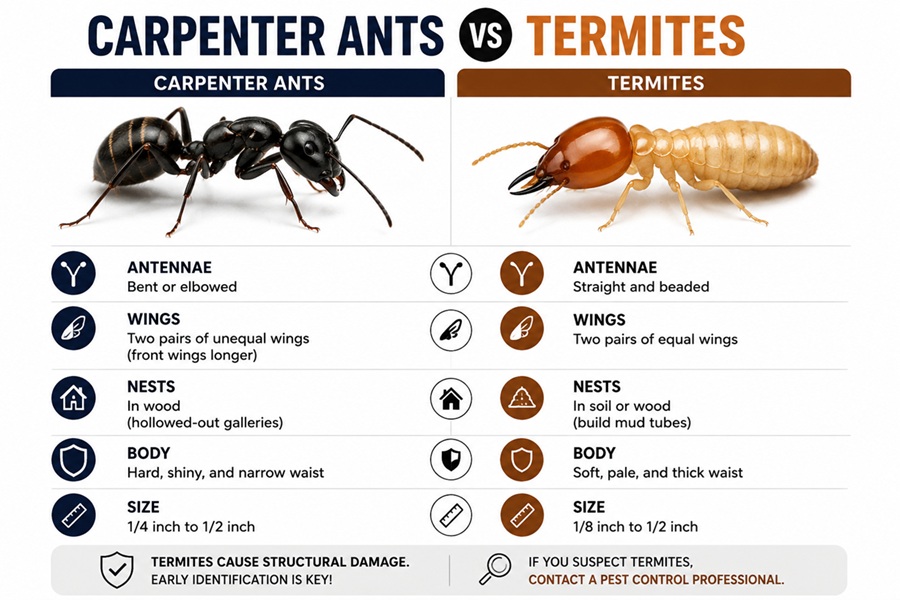
Carpenter ants and termites both damage wood, but they are very different pests: carpenter ants are large, dark, pinched-waist ants that excavate wood to nest without eating it, leaving clean galleries and sawdust-like frass, while termites are small, pale, broad-waisted insects that actually eat wood, leaving mud-packed galleries and no clean sawdust. The quickest way to tell which you have is the debris they leave behind, sawdust-like shavings point to carpenter ants, while mud tubes and soil-filled tunnels point to termites. Identifying the right pest matters because they require different treatments and cause damage at different speeds.
Confusing the two is common because both are found in and around wood, yet the distinction is important for protecting your home. This guide compares carpenter ants and termites across appearance, the damage they cause, the droppings they leave, and their behavior, giving you clear ways to tell them apart and understand what each means for your home.
| Carpenter ants | Large, dark, pinched-waist ants |
| Termites | Small, pale, broad-waisted insects |
| Ants and wood | Excavate to nest, do not eat it |
| Termites and wood | Actually eat the wood |
| Ant droppings | Sawdust-like frass with insect parts |
| Termite evidence | Mud tubes and soil-filled galleries |
| Damage speed | Termites often faster and more destructive |
| Treatment | Differs, so correct ID matters |
Appearance: Telling Them Apart
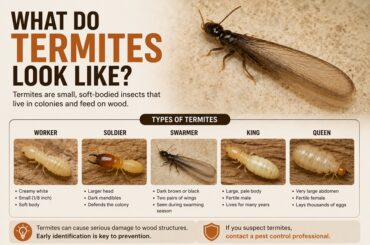
The insects themselves look quite different once you know what to check. Carpenter ants are among the larger ants, typically black or a mix of black and red, with the classic ant features: a narrow, pinched waist and bent, elbowed antennae. Termites are smaller and pale, from creamy white workers to darker swarmers, with a broad, uniform waist and straight antennae.
| Feature | Carpenter Ant | Termite |
| Size | Large | Small |
| Color | Black or black and red | Pale white to dark (swarmers) |
| Waist | Narrow, pinched | Broad, no pinch |
| Antennae | Bent (elbowed) | Straight |
| Wings (swarmers) | Front longer than rear | Equal length |
How They Damage Wood
This is the most important practical difference. Carpenter ants do not eat wood, they tunnel through it to build their nests, preferring wood that is already damp or damaged. Their galleries are smooth and clean, almost sanded-looking, because the ants remove the debris rather than consuming it. Termites, on the other hand, actually consume the wood as food, and their galleries are rougher and often packed with mud, soil, and their own droppings.
This difference affects both the look of the damage and its speed. Termites, especially in large colonies, can consume wood steadily and cause significant structural damage over time, often faster than carpenter ants, whose damage tends to progress more slowly since they are only excavating nesting space.
The Droppings Tell You a Lot
One of the easiest ways to identify the culprit without seeing the insect is to examine the debris. Carpenter ants push their excavated material out of the galleries, producing frass, a sawdust-like pile of fine wood shavings often mixed with insect body parts and other debris. Finding these neat piles of sawdust-like material near wood is a strong sign of carpenter ants. Termites do not leave clean sawdust; instead, subterranean termites build mud tubes and pack their tunnels with soil and mud, and drywood termites leave small, pellet-like droppings.
| Evidence | Points To | Description |
| Sawdust-like frass | Carpenter ants | Fine shavings with insect parts |
| Mud tubes | Termites | Pencil-thin soil tunnels |
| Pellet droppings | Drywood termites | Tiny wood-colored pellets |
| Clean galleries | Carpenter ants | Smooth, sanded-looking tunnels |
| Mud-packed galleries | Termites | Tunnels filled with soil |
Behavior and Habits
Behavior offers more clues. Carpenter ants are often seen out in the open, foraging for food, since unlike termites they do not eat wood and must hunt for other food sources, so spotting large ants trailing through your home is common. Termite workers, by contrast, stay hidden inside wood and soil and are rarely seen, which is why termite infestations often go unnoticed until swarmers appear or damage is found. Carpenter ants also prefer moist, decaying wood, so their presence can signal a moisture problem.
Why Correct Identification Matters
Getting the identification right is not just academic, because the two pests call for different responses. Carpenter ant control focuses on locating and eliminating nests, often with baits, and correcting the moisture that attracted them. Termite control involves different methods aimed at the colony and protecting the structure, frequently requiring professional treatment. Treating for the wrong pest wastes time and money while the real problem continues, so confirming which insect you have is the essential first step.
When to Call a Professional
For either pest, professional help is often worthwhile, but especially for termites given their potential for serious structural damage. If you find evidence of either but cannot confirm which, or if the infestation appears established, a pest professional can identify the culprit accurately, assess the extent, and recommend the right treatment. Early, correct action is far cheaper than repairing extensive damage discovered later.
Frequently Asked Questions
How do I tell carpenter ants from termites?
Look at the insect and the debris. Carpenter ants are large, dark, with a pinched waist and bent antennae, and leave sawdust-like frass. Termites are small, pale, with a broad waist and straight antennae, and leave mud tubes rather than clean sawdust.
Which is worse, carpenter ants or termites?
Termites are generally more destructive because they actually eat wood and can cause significant structural damage, often faster. Carpenter ants damage wood more slowly since they only excavate it for nesting, though they still warrant prompt attention.
Do carpenter ants eat wood like termites?
No. Carpenter ants tunnel through wood to build nests but do not eat it, pushing the debris out as sawdust-like frass. Termites actually consume wood as food, which is why their damage can accumulate faster.
Does sawdust mean termites or carpenter ants?
Sawdust-like frass points to carpenter ants, since they remove excavated wood as fine shavings. Termites do not leave clean sawdust; they leave mud tubes, soil-packed galleries, or small pellet droppings depending on the type.
Can I have both carpenter ants and termites?
Yes, since both are attracted to the same damp, damaged wood, a home with moisture problems can host both. That shared weakness is also why moisture control and drying out wood protect against both pests at once.
How often should I check for these pests?
Inspecting vulnerable areas a couple of times a year is sensible, more often if you have had problems before. In high-risk regions, an annual professional inspection adds an expert eye that catches subtle early signs.
Which pest should I worry about more?
Termites are generally more destructive because they eat wood and can cause serious structural damage, often faster than carpenter ants, which only excavate wood for nesting. Both deserve prompt attention, but termites carry the higher risk.
Preventing Both Carpenter Ants and Termites
Although carpenter ants and termites are different pests, they share a crucial weakness: both are drawn to moisture and damp wood, so the same preventive habits protect against both. Making your home dry and denying easy access goes a long way toward keeping either pest out, which is why prevention is far more efficient than fighting an established infestation of either.
Moisture control leads the list. Repair plumbing and roof leaks promptly, improve drainage so water flows away from the foundation, and ventilate damp areas. Replace any wood that is rotting or water-damaged, since it is prime real estate for both pests. Then cut off access: seal cracks and gaps, keep branches from touching the house, and move woodpiles and mulch away from the walls.
Regular inspection ties it together. Periodically checking vulnerable areas, basements, crawlspaces, around windows and doors, and any damp wood, helps you catch either pest early, when control is easier and damage is minimal. In high-risk regions, a professional inspection adds a valuable expert eye that can spot subtle signs a homeowner might miss.
- Fix leaks and improve drainage to control moisture
- Replace rotting or water-damaged wood
- Seal cracks and gaps around the home
- Keep branches, woodpiles, and mulch away from walls
- Inspect vulnerable areas regularly to catch problems early
Final Thoughts
Carpenter ants and termites both threaten wood, but they are easy to tell apart once you know the signs. Carpenter ants are large, dark, pinched-waist ants that excavate wood and leave sawdust-like frass, while termites are small, pale, broad-waisted insects that eat wood and leave mud and soil. The debris is often the fastest clue: sawdust means ants, mud means termites. Because the two need different treatments and termites can be especially destructive, identify the pest correctly, and call a professional when you need certainty or the problem looks established.