
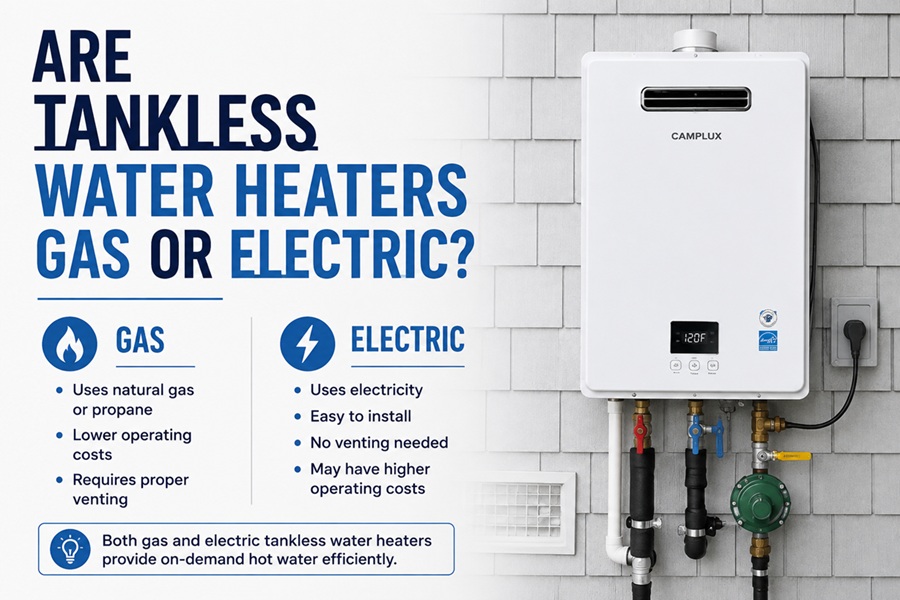
Tankless water heaters come in both gas and electric versions, so the answer is that they can be either, and the right one depends on your home and needs. Gas tankless heaters, powered by natural gas or propane, generally deliver higher flow rates suited to larger households, but need venting and often a larger gas line. Electric tankless heaters are simpler to install since they need no venting, and suit smaller homes or point-of-use spots, but a whole-home electric unit demands substantial electrical capacity. Both heat water on demand the same way; they simply use different energy sources.
Because both types exist and each has clear strengths, choosing between gas and electric is one of the first decisions when going tankless. Understanding how they differ in performance, installation, and cost helps you match the unit to your home’s utilities and your household’s hot water demand. This guide compares gas and electric tankless heaters and explains how to decide which is right for you.
| Available as | Both gas and electric |
| Gas fuel | Natural gas or propane |
| Electric fuel | Household electricity |
| Gas strength | Higher flow rate for larger demand |
| Electric strength | Simpler install, no venting |
| Gas needs | Venting and often a larger gas line |
| Electric needs | Ample electrical capacity, sometimes a panel upgrade |
| Both | Heat water on demand, no storage tank |
Both Types Heat on Demand
Whichever energy source they use, all tankless heaters share the same core operation: they heat water instantly as it flows, with no storage tank. When you open a hot tap, the unit activates and heats the water on the spot, delivering a continuous supply. The difference between gas and electric is purely in how that heat is generated, a gas burner versus electric heating elements, not in the on-demand principle itself. This is why both types share the headline benefits of endless hot water, efficiency, and a compact size.
Gas Tankless Heaters
Gas tankless heaters use a burner fueled by natural gas or propane to heat the water. Their main advantage is a higher flow rate, meaning they can supply more hot water at once, which makes them well suited to larger households that run multiple showers and appliances simultaneously. The trade-off is installation complexity: gas units require proper venting to expel combustion gases and often need a larger gas line to feed the powerful burner, which adds to the installation cost.
Electric Tankless Heaters
Electric tankless heaters use electric heating elements instead of a burner. Their big advantage is simpler installation, since they need no venting, which makes them easier to place and often suitable for smaller homes, apartments, or point-of-use applications like serving a single bathroom. The catch is that heating water instantly with electricity draws a lot of power, so a whole-home electric unit may require significant electrical capacity, sometimes even a service panel upgrade, to run properly.
Gas vs Electric at a Glance
Seeing the two side by side makes the trade-offs clear. Each suits different homes and demands.
| Factor | Gas Tankless | Electric Tankless |
| Flow rate | Higher, suits large demand | Lower, suits smaller demand |
| Installation | Needs venting and gas line | Simpler, no venting |
| Electrical needs | Modest | High, may need panel upgrade |
| Best for | Larger households | Small homes, point-of-use |
| Upfront cost | Often higher | Often lower unit cost |
Is gas or electric tankless cheaper to run?
It depends on local energy prices. Gas is often economical where natural gas is inexpensive, while electric running costs hinge on electricity rates. Compare your local gas and electricity prices, since the cheaper fuel varies by region.
Can I switch from a gas tank to an electric tankless heater?
You can, but a whole-home electric tankless unit may require significant electrical capacity, sometimes a panel upgrade, since it draws a lot of power. A qualified installer can confirm whether your electrical service can support it.
Which tankless type is easier to install?
Electric tankless heaters are generally simpler because they need no venting, unlike gas units that require venting and often a larger gas line. Your existing utilities and demand still determine which type is the better overall fit.
How to Choose Between Them
The right choice depends on a few practical factors about your home and usage. Consider what utilities you already have, since a home with an existing gas line leans naturally toward gas, while one without gas service may find electric more practical. Weigh your hot water demand: high simultaneous use across many fixtures favours a higher-flow gas unit, while a smaller home or a single-point application suits electric. Factor installation requirements and cost too, as needing to add a gas line and venting, or to upgrade your electrical panel, affects the total price.
- Choose gas if you have a gas line and high, simultaneous hot water demand
- Choose electric for smaller homes, no gas service, or point-of-use needs
- Consider which infrastructure upgrade, gas or electrical, your home would need
- Factor local energy costs for gas versus electricity
- Have a qualified installer assess your demand and utilities
Frequently Asked Questions
Can tankless water heaters be electric?
Yes. Tankless heaters come in electric versions that use heating elements instead of a gas burner. They need no venting, which simplifies installation, but a whole-home electric unit requires substantial electrical capacity to run.
Which is better, gas or electric tankless?
Neither is universally better; it depends on your home. Gas offers higher flow for larger households but needs venting and a gas line, while electric installs more simply and suits smaller homes, though it demands ample electrical capacity.
Do gas tankless heaters need venting?
Yes. Because they burn gas, they must be vented to expel combustion gases safely, and they often need a larger gas line. This makes their installation more involved than electric units, which require no venting.
Does electric tankless need a panel upgrade?
Sometimes. Heating water instantly with electricity draws significant power, so a whole-home electric tankless unit may require additional electrical capacity or a panel upgrade. A qualified installer can determine whether your panel can support it.
Which is cheaper to run, gas or electric tankless?
It depends on local energy prices. Where natural gas is inexpensive, gas tankless units are often economical to operate, while electric units’ running costs follow electricity rates. Comparing your local gas and electricity costs gives a clearer picture than the purchase price alone.
Is electric or gas tankless cheaper to install?
Electric units are usually simpler and cheaper to install because they need no venting, while gas units often require venting and sometimes a larger gas line, adding cost. Your home’s existing utilities heavily influence which install is cheaper.
Can I switch from a gas tank to an electric tankless?
You can, but it may require significant electrical capacity, possibly a panel upgrade, to run a whole-home electric tankless unit. A qualified installer can assess whether your panel supports it and compare the cost against a gas option.
Cost and Running Considerations
Beyond flow and installation, gas and electric tankless heaters differ in cost over their lifetime, which is worth weighing. Gas units often carry a higher upfront and installation cost, particularly if venting and a larger gas line are needed, but where natural gas is cheaper than electricity, they can cost less to run. Electric units frequently have a lower unit price and simpler installation, but running costs depend on local electricity rates.
Local energy prices are therefore a key part of the decision. In areas where natural gas is inexpensive, a gas tankless unit can be economical to operate over many years, helping offset its higher installation cost. Where electricity is relatively affordable, or where adding gas infrastructure would be costly, an electric unit may be the more sensible long-term choice. Comparing your local gas and electricity costs gives a clearer picture than the sticker price alone.
As always, a qualified installer is the best guide. They can assess your home’s existing utilities, size the unit to your demand, and lay out the true installed cost and expected running cost of each option. That expert input turns the gas-versus-electric question from guesswork into an informed choice tailored to your home.
- Gas often costs more to install but can run cheaper where gas is inexpensive
- Electric usually installs more simply with a lower unit price
- Local gas and electricity rates strongly affect running cost
- Adding gas infrastructure or upgrading a panel adds cost
- A qualified installer can compare true installed and running costs
Final Thoughts
Tankless water heaters are available in both gas and electric, and both heat water on demand with no storage tank. Gas units deliver higher flow for larger households but need venting and a gas line, while electric units install more simply and suit smaller homes and point-of-use needs, though they require ample electrical capacity. The right choice comes down to your existing utilities, hot water demand, and installation requirements. Match the type to your home with a qualified installer’s input, and you get all the benefits tankless has to offer.