
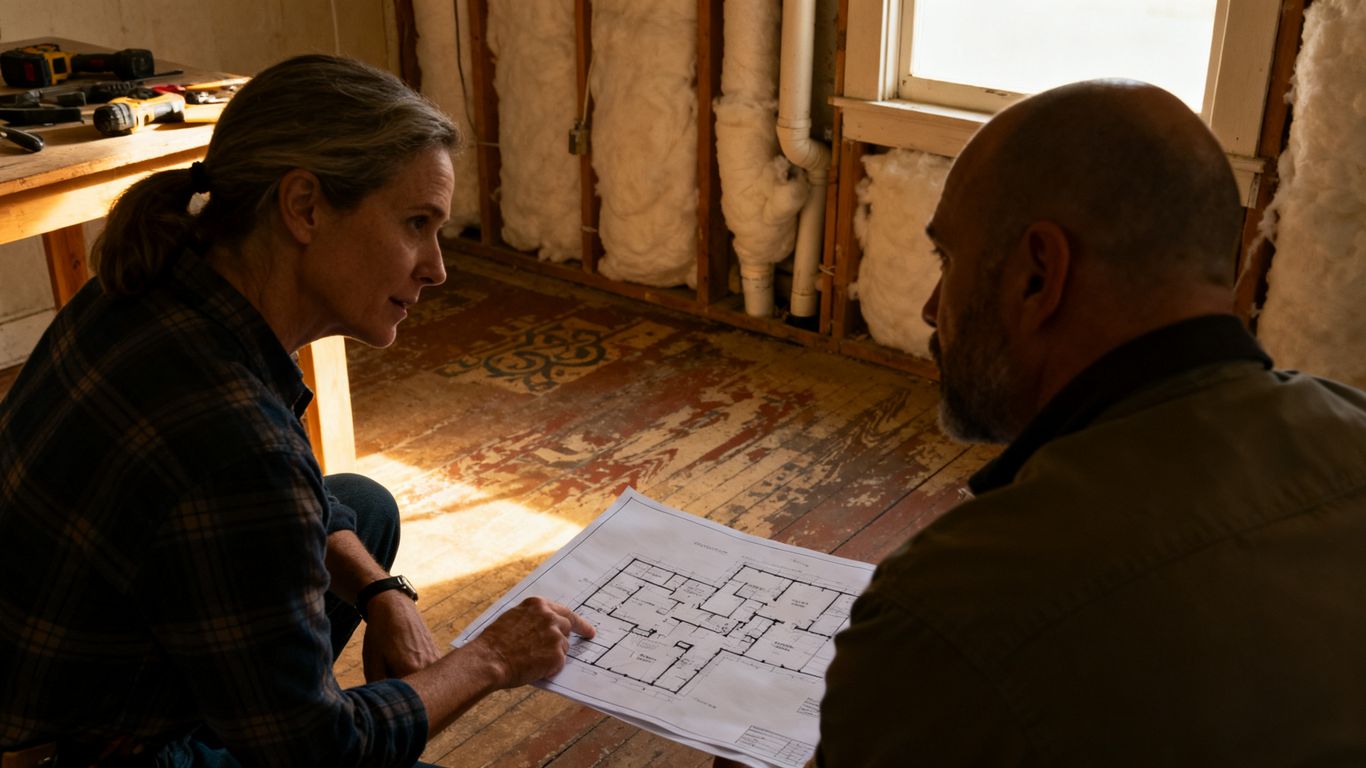
Asbestos testing is most useful when a renovation may disturb a material that could contain asbestos. The decision depends on the home’s age, the type of work planned, and the condition of the material. Because asbestos cannot be reliably identified by appearance alone, uncertainty is a reason to pause and seek qualified advice. Testing can help clarify what should happen before work begins.
How the age of your home affects the likelihood of asbestos
Asbestos was used in a range of building products, especially in homes built during the twentieth century. Older construction can raise the likelihood that some materials contain asbestos, but age alone does not confirm its presence or absence. Products and renovations may also have been added at different times, so a newer-looking finish does not necessarily settle the question. Homeowners can consult older-home asbestos guidance for examples of materials that may warrant attention.
Why planned demolition or repair changes the risk
The planned work matters because removing, drilling, scraping, or cutting a material can disturb it. A small repair may affect only one area, while a larger renovation can expose layers that have been covered for years. Before demolition or remodeling starts, it helps to identify which surfaces and building components will be altered. The work scope matters as much as the material’s appearance when deciding whether to arrange an inspection or testing.
When intact materials may be safer left undisturbed
A material that is in good condition and will remain untouched may not require immediate removal. Disturbing it without a clear reason can create a risk that did not exist while it remained intact. If a renovation can be redesigned to leave a suspect material in place, that may be worth discussing with a qualified professional. The choice should account for the material’s condition and whether future work could disturb it.
Where asbestos may be found in a home
Asbestos may be present in different building products, and its location can vary from one home to another. A surface’s color, texture, or age is not enough to confirm what it contains. Renovation plans should take account of concealed layers as well as finishes that are easy to see. Knowing common locations can help homeowners decide what to have assessed before work begins.
Flooring, adhesives, and underlayment
Some older floor tiles, backing materials, and adhesives may contain asbestos. Renovation can expose several layers beneath the visible floor, including older coverings that were left in place during previous updates. Removing flooring, scraping adhesive, or sanding a surface can disturb those layers. If the work will reach an unknown layer, it is better to pause and have the material assessed rather than assume it is harmless.
Insulation, pipes, and heating systems
Insulation around pipes, boilers, furnaces, or other heating equipment is one possible location for asbestos-containing material. Pipe coverings and insulation may be hidden behind walls or in utility spaces, where they can be overlooked during early planning. Work on heating systems or plumbing can bring these materials into the project area. A qualified inspector can help identify suspect materials without relying on a homeowner’s visual guess.
Siding, roofing, and textured finishes
Some siding, roofing products, textured finishes, and ceiling treatments may also warrant attention in older homes. Renovation or repair can disturb these materials through drilling, scraping, or removal. Before exterior work or ceiling updates begin, homeowners should note any layers that may be affected and ask a professional whether further assessment is appropriate. The absence of visible damage does not establish what a product contains.
How asbestos exposure can happen during renovation
Asbestos exposure can occur when material containing asbestos is disturbed and fibers become airborne. The risk is tied to what happens to the material, not simply to whether it is present in a building. Homeowners should therefore consider how contractors will access, cut, remove, or repair the areas in scope. Planning ahead can prevent avoidable disturbance and help determine when professional testing is needed.
Why cutting, sanding, or breaking materials can release fibers
Cutting, sanding, drilling, scraping, and breaking can damage materials and release fibers if asbestos is present. The same concern applies when a material is removed or crumbles during work. Routine renovation tools can disturb more than the visible finish, especially when several layers are involved. Avoid working on suspect materials until they have been assessed and the appropriate next steps are clear.
How airborne fibers differ from visible dust
Asbestos fibers are too small to identify by sight, so visible dust is not a reliable measure of whether fibers are present in the air. A work area that looks clean does not prove that suspect material was left undisturbed, and dust alone cannot confirm asbestos. For information on the range of sample types that can be analyzed, ETR Laboratories describes testing of samples from building materials, while Pace® describes asbestos testing services for air, bulk materials, soil, dust, and water. Those descriptions concern testing services; they do not allow a homeowner to determine exposure by looking at a room.
Why stopping work matters if suspicious material is uncovered
If a renovation exposes an unknown or suspicious material, work in that area should stop while the situation is assessed. Continuing to cut, sweep, or remove debris could spread contamination if asbestos is present. Keep other people away from the immediate work area and avoid handling the material while arranging qualified advice. A pause gives the homeowner and contractor time to decide whether inspection, sampling, or another protective measure is appropriate.
How to choose an asbestos testing approach
The right approach depends on the material, its condition, and the renovation activity planned. A visual inspection can help locate suspect products and inform next steps, but it cannot confirm asbestos by appearance alone. When confirmation is needed, a sample must be analyzed by a laboratory. Homeowners should weigh the value of reliable information against the risks of collecting a sample themselves.
What a professional inspection can and cannot determine
A qualified inspector can assess the areas relevant to the renovation, identify materials that may warrant testing, and explain possible next steps. An inspection is useful for defining the scope of concern, but visual assessment by itself cannot establish whether a material contains asbestos. The homeowner should ask what areas were inspected, what limitations apply, and whether laboratory analysis is recommended. Those details help prevent a limited inspection from being mistaken for a guarantee about every material in the home.
When laboratory analysis is needed to confirm asbestos
Laboratory analysis is needed when a reliable determination of a material’s contents is required. The material must be sampled and submitted for analysis using an appropriate process. ETR Laboratories describes testing samples from building materials, and Pace® lists methods including Polarized Light Microscopy, Phase Contrast Microscopy, and Transmission Electron Microscopy for its asbestos testing services. Homeowners should ask the inspector or laboratory which type of analysis fits the sample and purpose, rather than infer a result from a product’s appearance.
Why DIY sampling can create exposure and unreliable results
Collecting a sample can disturb the very material the homeowner is trying to identify. A poorly chosen or unrepresentative sample may also fail to answer the renovation question, even if it reaches a laboratory. Some companies offer at-home asbestos test kits, but a kit does not remove the need to handle suspect material carefully or follow its instructions. Homeowners who are unsure how to sample safely can ask a qualified professional to guide the process instead.
What to do if testing confirms asbestos
A positive result does not automatically mean that every material must be removed. The next step depends on where the material is, whether it is damaged, and whether the renovation will disturb it. Homeowners should avoid disturbing it while they review the findings with a qualified professional. A clear plan can address both immediate work and how the material will be managed over time.
How the condition and location affect next steps
The condition of the material and its position in the home help determine what action may be appropriate. A stable material that is out of the renovation area presents a different planning issue from damaged material that contractors need to remove. The report should be matched to the actual project scope, including any concealed areas that may be affected. If the scope changes, the homeowner should revisit the assessment before work proceeds.
When encapsulation or leaving material in place may be appropriate
If asbestos-containing material is intact and can remain undisturbed, leaving it in place may be considered. Encapsulation may also be appropriate in some situations, depending on the material and the professional assessment. Neither option should be treated as a universal solution; the condition, location, and likelihood of future disturbance matter. The homeowner should keep records of the findings and any management steps for future repairs or renovations.
When removal or abatement may be needed
Removal or other abatement may be needed when material is damaged, is likely to be disturbed, or stands in the way of planned work. The work should be handled by qualified professionals using appropriate controls, rather than treated as ordinary demolition. Before hiring a contractor, homeowners should understand what areas are included, how the work will be managed, and what documentation will be provided. The renovation schedule should leave room for this work before other trades return to the affected area.
How to plan renovation work safely
Safe planning starts before contractors open walls, remove flooring, or begin demolition. Homeowners can reduce uncertainty by arranging an assessment early and sharing the renovation scope with the professionals involved. Local and state requirements may affect inspection, notification, or abatement, so project teams should check them before work begins. Testing and renovation schedules should be coordinated so that no one proceeds on an unresolved assumption.
Finding qualified asbestos inspectors and abatement contractors
Homeowners should look for inspectors and abatement contractors with relevant training, experience, and qualifications for the work being considered. They can ask what the inspection covers, how samples will be handled, and what the final report will explain. For abatement, it is useful to confirm the proposed work area, containment and cleanup approach, and documentation in writing. The answers should make clear who is responsible for each step.
Checking local and state requirements before work begins
Rules for asbestos-related work can vary by location and by the type of property or project. Before scheduling demolition or removal, homeowners and contractors should check applicable state and local requirements and ask the relevant agency if anything is unclear. Arkansas homeowners can consult the state health department’s asbestos information for location-specific background. Requirements should be confirmed for the actual project rather than assumed from guidance for another jurisdiction.
Coordinating testing, abatement, and contractor schedules
The renovation schedule should allow time for inspection, any needed laboratory analysis, and abatement before affected areas are handed back to general contractors. A practical sequence is to identify the work area, resolve questions about suspect materials, complete any necessary abatement, and then confirm when renovation can resume. Everyone on the project should know which areas are off limits and who will communicate that work is ready to proceed. That coordination can prevent trades from disturbing material while results or abatement work are still pending.