
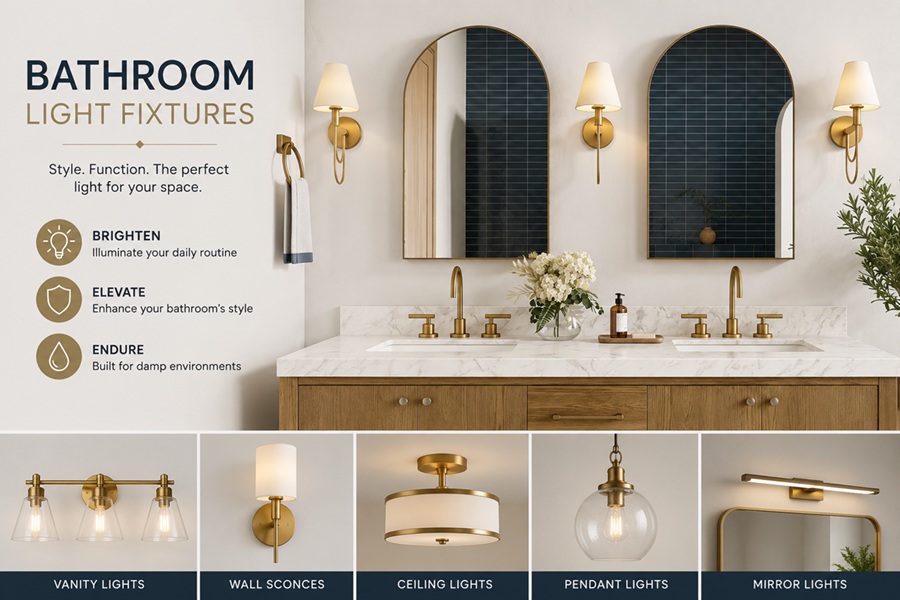
Bathroom light fixtures fall into three roles that work best together: task lighting at the vanity where you groom, ambient lighting overhead to fill the room, and accent lighting for mood or highlighting features. The single most important rule is to light the face evenly at the mirror, ideally with fixtures on either side of it, rather than relying on one downward ceiling light that casts unflattering shadows. Get that layering right and the bathroom becomes both more functional and more inviting.
Because bathrooms are wet, humid spaces, fixture choice is not only about looks. Safety ratings matter, bulbs need the right color and brightness, and placement makes or breaks how the room feels. This guide walks through every fixture type, where each belongs, the ratings and bulbs to look for, and how to combine them so your bathroom is lit like a well-designed hotel rather than a dim afterthought.
| Three lighting roles | Task, ambient, and accent |
| Best vanity setup | Fixtures on both sides of the mirror |
| Ideal color temperature | Around 2700K to 3000K for a warm, flattering light |
| Safety rating | Damp or wet rated depending on location |
| Common fixtures | Vanity bars, sconces, ceiling lights, recessed |
| Best bulb type | LED for efficiency and long life |
| Dimming | Highly recommended for flexibility |
| Avoid | A single overhead light as the only source |
The Three Layers of Bathroom Lighting
Good bathroom lighting is never one fixture doing everything. It is a combination of layers, each with a job. Task lighting is the workhorse at the mirror, where you shave, apply makeup, and get ready, and it needs to hit your face evenly from the sides. Ambient lighting is the general fill that lets you see the whole room safely, usually from the ceiling. Accent lighting is the finishing touch, drawing the eye to a feature wall, a niche, or a tub, and adding warmth after dark.
When these layers work together, the room feels balanced and functional at any hour. When they do not, you get the classic problem of a single ceiling light throwing harsh shadows down over your eyes at the mirror, which is unflattering and genuinely unhelpful for grooming. Thinking in layers is the mindset that fixes almost every bathroom lighting complaint.
Fixture Types and Where They Belong
Each fixture type suits a particular role and location. Matching the fixture to the job is how you build those layers.
| Fixture | Primary Role | Best Placement |
| Vanity bar | Task lighting | Above or beside the mirror |
| Wall sconces | Task lighting | Flanking the mirror at eye level |
| Flush / semi-flush | Ambient lighting | Center of the ceiling |
| Recessed lights | Ambient lighting | Spread across the ceiling |
| Pendant | Accent or task | Over a tub or large vanity |
| LED strips | Accent lighting | Under vanities or in niches |
Why Vanity Lighting Matters Most
If you only upgrade one thing, make it the vanity lighting, because that is where you actually use the bathroom mirror. The gold-standard setup is a pair of fixtures, sconces or vertical bars, mounted on either side of the mirror at roughly eye level. This lights your face evenly from both sides and eliminates the shadows under the eyes, nose, and chin that a single overhead source creates.
If side mounting is not possible, a horizontal vanity bar above the mirror is the next best option, ideally wide enough to spread light across your whole face. Whatever the configuration, aim the light at the person using the mirror, not at the mirror itself, and you will immediately see the difference in how easy grooming becomes.
Safety Ratings You Must Not Ignore
Bathrooms combine electricity with water and steam, so fixtures carry moisture ratings you need to respect. A damp-rated fixture is built to handle humidity and is fine for most of the bathroom, away from direct water. A wet-rated fixture can handle direct water contact and is required for locations like inside a shower or directly over a tub. Using the wrong rating in a wet zone is both a safety hazard and a code issue, so always check the label against where the fixture will go.
Choosing the Right Bulbs
The bulb shapes the whole experience as much as the fixture. Two specs matter most: color temperature and brightness. For color, a warm-to-neutral range around 2700K to 3000K flatters skin and feels welcoming, while very cool, blue-white light can look clinical. For brightness, the vanity area benefits from a good, usable level so you can see clearly, while ambient light can be softer.
- Choose LED bulbs for efficiency, low heat, and long life
- Aim for warm-to-neutral color, roughly 2700K to 3000K
- Look for a high color rendering rating so skin tones look true
- Provide strong, even light at the vanity for grooming
- Add dimmers so one fixture serves both day and night
The Case for Dimmers
Dimming transforms a bathroom from a single-setting room into one that flexes with the time of day. Bright, full light is welcome in the morning when you are getting ready, but the same intensity at midnight is jarring. A dimmer lets you drop the light to a soft glow for a relaxing bath or a middle-of-the-night trip without blasting your eyes awake. It is an inexpensive upgrade that dramatically improves how the space feels, and it pairs perfectly with the layered approach.
Common Lighting Mistakes
- Relying on a single ceiling light, which casts facial shadows
- Mounting a vanity light too high so it lights hair, not the face
- Using cold, blue-white bulbs that make skin look washed out
- Ignoring moisture ratings near the shower or tub
- Forgetting a dimmer and being stuck at one harsh brightness
- Mixing wildly different color temperatures across fixtures
Frequently Asked Questions
What is the best lighting for a bathroom mirror?
Fixtures mounted on both sides of the mirror at roughly eye level are ideal, since they light the face evenly and remove shadows. A wide horizontal bar above the mirror is the next best option if side mounting is not possible.
What color light is best in a bathroom?
A warm-to-neutral white around 2700K to 3000K is most flattering and inviting. Very cool, blue-toned light can feel clinical and make skin tones look off, which is not ideal where you groom.
Do bathroom lights need to be a special type?
Yes, fixtures must match the moisture of their location. Damp-rated fixtures suit general bathroom areas, while wet-rated fixtures are required inside showers or directly over tubs where they may contact water.
How many lights does a bathroom need?
It depends on size, but most bathrooms benefit from at least a vanity light plus a ceiling source, layering task and ambient light. Larger rooms may add recessed lights or accents to fill the space evenly.
Can I put bathroom lights on a dimmer?
Yes, and it is well worth doing. Dimmable LED fixtures let one light serve bright morning grooming and a soft evening glow, and dimmers are inexpensive to add when you install compatible bulbs and a compatible switch.
Are LED fixtures good for bathrooms?
Very much so. LEDs run cool, last for years, and sip electricity, and they come in the warm color temperatures that flatter skin. Just confirm any fixture near water carries the right damp or wet rating for its location.
Where should recessed lights go in a bathroom?
Spread them across the ceiling to fill the room evenly, and add one over the shower using a wet-rated fixture. Recessed lights work best as ambient support alongside dedicated vanity lighting rather than as the only source.
Adding Smart and Layered Control
Once your fixtures are in place, how you control them is the final piece that separates a good bathroom from a great one. Putting different layers on separate switches lets you use only the light you need at any moment. The vanity lights, the ceiling fill, and any accent strips ideally run on their own controls, so you can flood the room in the morning yet keep only a soft glow for a late-night visit.
Smart bulbs and switches push this further. They let you dim from a wall panel or your phone, set scenes that combine layers at preset levels, and even schedule the lights to warm and soften in the evening. In a bathroom, a gentle night-light setting is especially welcome, giving you just enough light to see without the jolt of full brightness that ruins your chances of falling back asleep.
- Put vanity, ceiling, and accent lights on separate switches
- Add a dimmable night-light setting for late visits
- Use smart bulbs to save scenes for morning and evening
- Keep all layers in the same warm color family for cohesion
- Consider a motion sensor for a hands-free low light at night
Final Thoughts
Bathroom lighting is less about a single fixture and more about layers working together: even task light at the mirror, soft ambient fill overhead, and accents for warmth. Prioritize side-mounted vanity lighting, respect the moisture ratings, choose warm LED bulbs, and add a dimmer for flexibility. Nail those fundamentals and a plain, shadowy bathroom turns into a space that is both practical for grooming and genuinely pleasant to spend time in.