
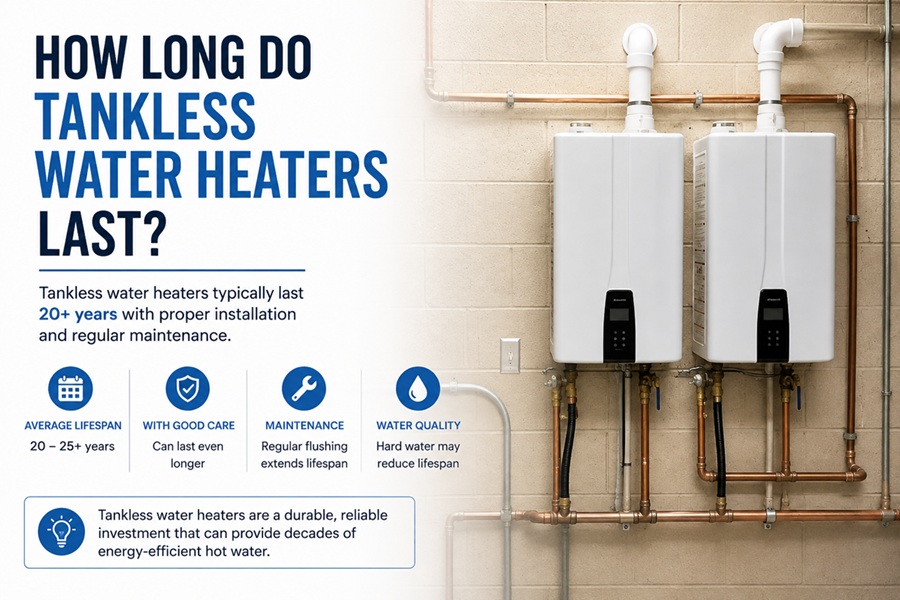
Tankless water heaters typically last around 20 years or more, notably longer than conventional tank water heaters, which usually last about 8 to 12 years. That extended lifespan is one of the biggest selling points of going tankless, and it comes from their on-demand design, which avoids the constant wear of holding and reheating a tank of water. With proper maintenance, especially regular descaling in hard-water areas, many tankless units comfortably reach or exceed two decades of service, roughly double what you would expect from a tank.
That longevity, though, is not automatic. How long your tankless heater lasts depends heavily on water quality, maintenance, and installation. Understanding what drives the lifespan, and what shortens it, lets you get the full twenty-plus years out of your investment. This guide covers the typical lifespan, why tankless units outlast tanks, the factors that affect longevity, and the simple steps that extend it.
| Typical tankless lifespan | Around 20 years or more |
| Typical tank lifespan | About 8 to 12 years |
| Why tankless lasts longer | No stored, constantly reheated water |
| Biggest threat | Mineral scale from hard water |
| Key maintenance | Regular descaling or flushing |
| Also helps | Cleaning the inlet filter |
| Bonus | Often replaceable parts extend life further |
| Best practice | Follow the maker’s maintenance schedule |
The Typical Lifespan
Most tankless water heaters are built to last around twenty years, and many exceed that with good care. This roughly doubles the life of a standard tank heater, which typically gives out somewhere between eight and twelve years. Over the life of your home, that difference can mean installing one tankless unit where you might otherwise replace two or more tank heaters, which factors into the long-term value despite the higher upfront cost.
Why Tankless Units Outlast Tanks
The longevity advantage comes down to design. A tank water heater constantly holds water and reheats it around the clock, and that stored water slowly corrodes the tank from the inside. Eventually the tank rusts through and leaks, ending its life, which is why tank heaters have a relatively fixed lifespan. A tankless unit stores no water and only heats when needed, so it avoids the continuous corrosion that kills tanks. Many tankless heaters are also built with replaceable parts, meaning a worn component can sometimes be swapped rather than replacing the whole unit.
What Affects How Long Yours Lasts
Several factors determine whether your unit reaches the low end or the high end of its potential lifespan. Water quality and maintenance are the biggest.
| Factor | Effect on Lifespan | Notes |
| Water hardness | Hard water shortens life | Scale builds up inside |
| Maintenance | Regular care extends life | Descaling is key |
| Installation quality | Poor install shortens life | Use a qualified installer |
| Usage | Very heavy use adds wear | Sizing matters |
| Fuel type | Both can last long | Gas and electric both durable |
The Enemy: Mineral Scale
The single biggest threat to a tankless heater’s lifespan is mineral scale from hard water. As water passes through the heat exchanger, minerals like calcium can deposit on its surfaces, building up over time. This scale reduces efficiency, makes the unit work harder, and can eventually damage the heat exchanger, shortening the heater’s life. Homes with hard water are especially prone to this, which is why descaling is so important. A water softener can also reduce scale buildup and protect the unit.
How to Extend the Lifespan
The good news is that a little regular maintenance keeps a tankless heater running well for its full potential life. These simple steps make a real difference.
- Descale or flush the unit regularly, typically once a year, more often with hard water
- Clean the inlet water filter as the manufacturer recommends
- Consider a water softener if you have hard water
- Have it installed and serviced by a qualified professional
- Address any performance issues promptly rather than letting them worsen
- Follow the manufacturer’s maintenance schedule
When should I replace a tankless water heater?
Consider replacement when the unit struggles to hold temperature, throws frequent error codes, needs increasingly costly repairs, or loses efficiency despite descaling, especially as it approaches or passes the 20-year mark. Rising repair bills on an old unit favour replacing it.
Does regular use wear out a tankless heater faster?
Very heavy use adds some wear, but maintenance and water hardness matter far more. A frequently used unit that is descaled regularly often outlasts a lightly used one that is never maintained, since scale buildup is the main threat.
Signs Your Tankless Heater Is Aging
Even a long-lived unit eventually shows its age, and recognizing the signs helps you plan. Declining performance, such as water that is not as hot, inconsistent temperatures, reduced flow, or error codes, can indicate scale buildup or wear. Often these are fixable with descaling or a part replacement rather than a full replacement, especially given how repairable tankless units tend to be. But as a unit approaches or passes twenty years, persistent problems may signal it is time to plan for a new one.
Frequently Asked Questions
How long does a tankless water heater last on average?
Around twenty years or more with proper maintenance, roughly double the eight-to-twelve-year lifespan of a conventional tank heater. Water quality and regular descaling strongly influence where a given unit falls in that range.
What shortens a tankless water heater’s life?
Mineral scale from hard water is the biggest culprit, along with skipped maintenance and poor installation. Scale builds up in the heat exchanger, reducing efficiency and eventually causing damage if not addressed with regular descaling.
Do tankless water heaters need maintenance to last?
Yes. Regular descaling or flushing, typically once a year and more often with hard water, plus cleaning the inlet filter, is what allows a tankless unit to reach its full lifespan of twenty years or more.
Can you repair a tankless water heater instead of replacing it?
Often, yes. Many tankless units are built with replaceable parts, so a worn component can be swapped rather than replacing the whole heater, which is part of why they last so long compared with tanks.
Do tankless water heaters lose efficiency as they age?
They can if mineral scale builds up in the heat exchanger, which is why regular descaling matters, especially with hard water. Well-maintained units hold their efficiency well across their long lifespan, while neglected ones gradually work harder and heat less effectively.
How do I know when to replace a tankless heater?
As a unit approaches or passes twenty years, persistent problems despite descaling and repairs, such as inconsistent temperatures, reduced flow, or recurring error codes, suggest it is time to plan a replacement. Many issues before then are fixable rather than terminal.
Does a water softener help a tankless heater last longer?
Yes, in hard-water areas. A softener reduces the mineral content that forms scale inside the heat exchanger, which is the biggest threat to a tankless unit’s lifespan, helping it run efficiently and reach its full potential life.
The Long-Term Value of a Long Life
The impressive lifespan of a tankless heater is not just a convenience; it is central to its financial case. Because a tankless unit can last around twenty years or more, roughly double a tank, one tankless heater may serve where you would otherwise buy and install two or more tank heaters over the same period. Factoring in the avoided replacements helps justify the higher upfront cost of going tankless.
That longevity pairs with the energy savings for a compounding effect. Over two decades, the reduced running costs from on-demand heating add up, and avoiding a mid-life tank replacement, with its own unit and installation cost, adds further value. When people ask whether tankless is worth the premium, the long lifespan is a big part of the answer, especially for those staying in their home for many years.
Maintenance is what protects this value, which is why it is worth repeating: regular descaling and filter care keep the unit reaching its full potential life. Skipping maintenance, particularly in hard-water areas, can cut the lifespan short and erode the very advantage that makes tankless economical. A modest maintenance habit safeguards a decades-long return.
- One tankless unit can outlast two or more tanks
- Avoided replacements help offset the higher upfront cost
- Energy savings compound over a long lifespan
- The value is greatest for long-term homeowners
- Maintenance protects the lifespan that makes it worthwhile
Final Thoughts
Tankless water heaters last around twenty years or more, roughly double a conventional tank, thanks to a design that avoids the constant corrosion of stored water. That impressive lifespan depends on care, though: mineral scale from hard water is the main threat, so regular descaling, filter cleaning, and quality installation are what let a unit reach its full potential. Maintain it well, consider a softener in hard-water areas, and a tankless heater rewards you with two decades or more of efficient, on-demand hot water.